
In This Guide
What Compressor Amp Draw Actually Tells You
Compressor amp draw is the electrical current flowing through the compressor motor while it starts or runs. It is one of the most useful measurements in an air-conditioning diagnosis, but it is also one of the most frequently misunderstood. A current reading is not a stand-alone verdict. It is a clue that must be interpreted with voltage, refrigerant pressures, temperatures, airflow, capacitor condition, condenser performance, compressor capacity, and the exact operating mode.
A compressor converts electrical energy into mechanical work. When the motor must work harder, current often increases. When the refrigerant load is light, the compressor is unloaded, or the system is starved, current may decrease. But the same current value can mean very different things on two different systems. A 4-ton single-stage scroll compressor on a 100°F afternoon will not draw the same current as a 2-ton unit during mild weather, and a variable-speed compressor may intentionally change current from minute to minute.
Quick answer
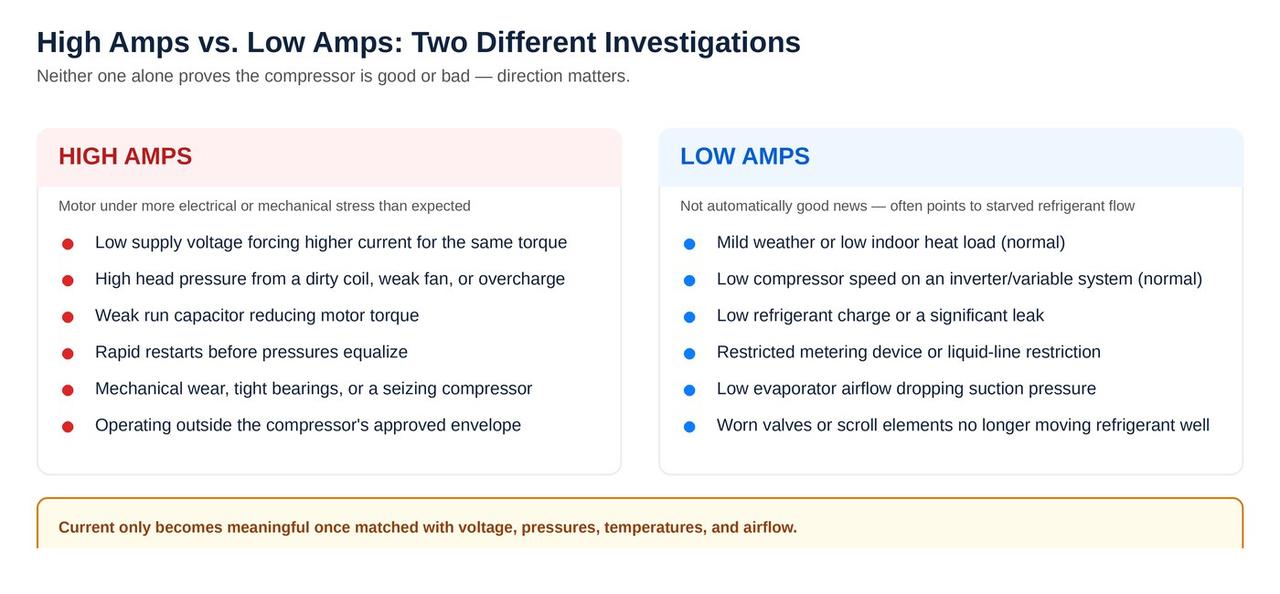
High compressor amps do not automatically mean the compressor is bad, and low amps do not automatically mean it is healthy. The technician must determine whether the current matches the compressor model and the conditions under which it is operating.
RLA, FLA, MCA and LRA: Do Not Treat Them as the Same Number
The outdoor unit nameplate may show several electrical values. Each serves a different purpose. Reading the wrong number—or comparing a field measurement with a number that was never intended as a performance target—can lead to a false diagnosis.
| Term | What it means | How it should be used |
|---|---|---|
| RLA Rated Load Amps | A compressor nameplate value associated with motor protection and equipment design. | Use as a reference with manufacturer data and operating conditions. Do not assume the compressor must draw exactly RLA. |
| FLA Full Load Amps | A full-load current term commonly used for motors and some equipment components. | Confirm whether the value applies to the compressor, fan motor, or another load. |
| LRA Locked Rotor Amps | Current associated with a motor that is not rotating. | Useful when evaluating startup, stalled compressors, breaker trips, and starting components. |
| MCA Minimum Circuit Ampacity | The minimum conductor ampacity required for the entire outdoor unit. | Used for branch-circuit conductor sizing—not as a compressor running-current target. |
| MOCP / Max Fuse | Maximum permitted overcurrent protection for the unit. | Used to select the proper breaker or fuse within the manufacturer's limit. |
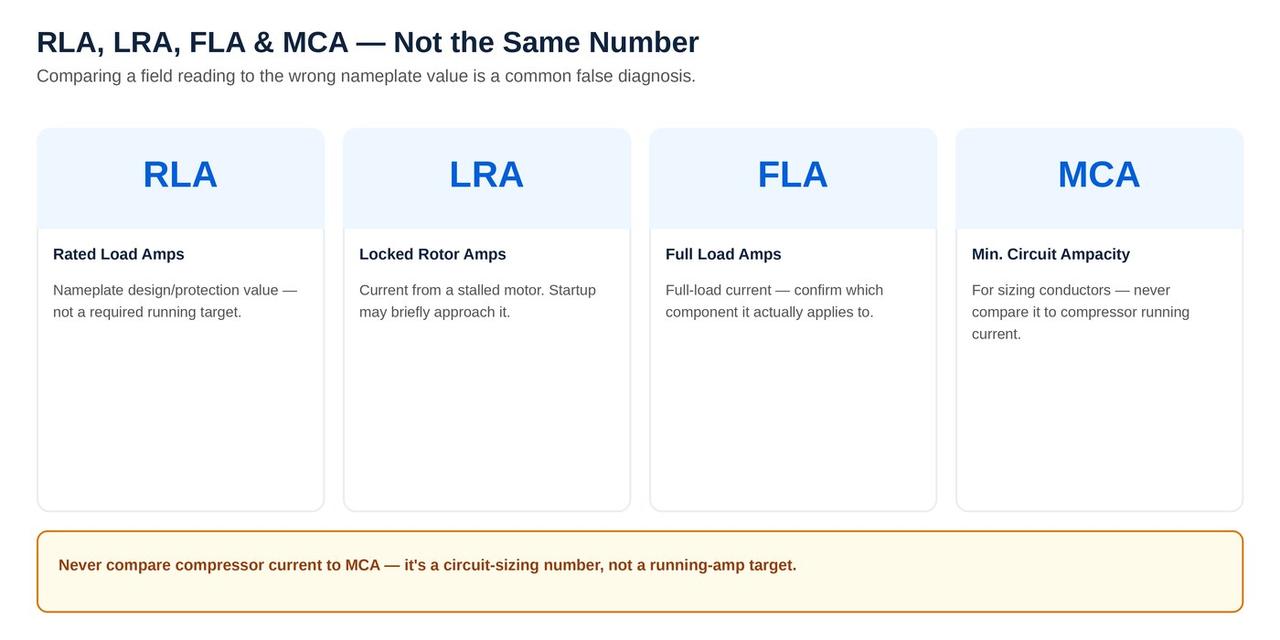
Copeland explains that compressor nameplate amperage is tied to recognized motor protection and rating practices. That is why a measured current below the printed RLA can be perfectly normal. The goal is not to force a compressor to match the label; the goal is to determine whether the current is reasonable for the load and whether the motor is operating safely.
Important distinction
Never compare compressor current with the outdoor unit's MCA. MCA includes circuit-sizing considerations for multiple loads and is not the compressor's expected running amperage.
How a Technician Measures Compressor Amp Draw Correctly
Accurate current measurement begins with safe access, correct meter setup, and identification of the compressor conductors. A clamp meter must surround one conductor—not the entire cable or both legs together. On a single-phase compressor, the technician may measure common, run, and start conductors for different diagnostic purposes. The current at the line feeding the compressor contactor may differ from a winding-lead measurement depending on how the circuit is arranged.
- Confirm the equipment and operating mode. Identify the condenser model, compressor model, refrigerant, staging, and whether the system is single-stage, two-stage, variable-capacity, or inverter-driven.
- Inspect before energizing. Look for burnt terminals, loose lugs, damaged wires, oil marks, swollen capacitors, overheated contactors, and signs of a previous electrical event.
- Measure supply voltage with the system running. Voltage must be checked under load because a weak connection or undersized circuit can look acceptable when the compressor is off and collapse during operation.
- Clamp one compressor conductor. Use a properly rated true-RMS meter and confirm the conductor being measured.
- Observe startup and stabilization. Starting current, first-minute current, and stabilized running current answer different questions.
- Record operating conditions. Outdoor temperature, return and supply temperatures, suction and liquid pressures, superheat, subcooling, fan performance, and coil condition provide the context for the amp reading.
- Compare with reliable data. Use the equipment nameplate, compressor data, manufacturer performance tables, and prior measurements when available.
Electrical safety
Outdoor units contain high voltage and stored capacitor energy. Current testing should be performed by trained HVAC personnel using properly rated instruments and personal protective equipment. Homeowners should not remove service panels or place meters inside energized equipment.
What Causes High Compressor Amp Draw?
High current means the compressor motor is under greater electrical or mechanical stress than expected for the conditions. The cause may be external to the compressor, internal to the compressor, or a combination of both.
Low supply voltage
When voltage falls, a motor may draw more current to produce the required torque. Loose disconnects, burnt contactor contacts, weak utility voltage, undersized conductors, or poor connections can create voltage drop under load.
High head pressure
A dirty condenser coil, blocked airflow, recirculating hot discharge air, a weak condenser fan, overcharge, noncondensables, or a liquid-line restriction can increase the work required to compress refrigerant.
Weak run capacitor
A capacitor below its microfarad rating can reduce phase shift and motor torque, increase winding current, create hard starts, and contribute to thermal overload trips.
Rapid restarts
Restarting before system pressures equalize can make the compressor start against a high differential. Thermostat short cycling, contactor chatter, power interruptions, or failed time-delay controls can cause repeated high-current starts.
Mechanical wear or tight compressor
Internal friction, damaged scroll sets, bearing problems, liquid slugging damage, oil loss, or a compressor beginning to seize can raise current and temperature.
Incorrect operating envelope
Very high compression ratio, low suction density, excessive discharge temperature, or operation outside the compressor's approved application range can overheat and overload the motor.
| Finding | Possible direction | What must be checked next |
|---|---|---|
| High amps + low voltage | Electrical supply or connection problem | Voltage at disconnect, contactor, compressor terminals, conductor heating, utility supply |
| High amps + high head pressure | Condenser airflow, overcharge, noncondensables, restriction | Coil condition, fan RPM/amps, subcooling, ambient, liquid-line temperature |
| High amps + low capacitance | Weak run capacitor or incorrect replacement | Microfarads, tolerance, wiring, terminal condition, compressor startup |
| High amps + repeated overload trips | Heat, voltage, pressure, mechanical or winding problem | Shell temperature, winding resistance, pressures, cooling, insulation test |
| Near-LRA current that does not fall | Locked or stalled compressor | Immediately de-energize; test capacitor, voltage, windings, mechanical condition |
For related electrical symptoms, see Bad Capacitor vs. Bad Compressor, Locked-Rotor Symptoms, and Hard-Start Kit Explained.
What Low Compressor Amps Can Mean
Low running current is not automatically good news. It may simply mean the compressor is lightly loaded, but it can also point toward a starved evaporator, low refrigerant mass flow, incorrect staging, or a compressor that is no longer pumping as designed.
Normal reasons for lower current
- Mild outdoor temperature and low indoor heat load
- Low compressor speed on an inverter or variable-capacity system
- Second stage not commanded on a two-stage system
- System recently started and not yet fully loaded
- Indoor temperature close to setpoint
Diagnostic reasons for lower-than-expected current
- Low refrigerant charge or a significant refrigerant leak
- Restricted metering device or liquid-line restriction
- Low evaporator airflow causing low suction pressure
- Compressor valves or scroll elements no longer moving refrigerant effectively
- Incorrect compressor speed command or inverter limitation
- Wrong compressor, wrong refrigerant, or mismatched equipment
Current must follow the refrigeration circuit
A low-amp compressor with low suction pressure, low mass flow, and poor cooling may be unloaded because the evaporator is starved. The repair could involve airflow, refrigerant charge, a restriction, or compressor capacity—not the electrical circuit itself.
Related guides: Low Refrigerant Symptoms, Refrigerant Restriction Symptoms, and How to Test an AC Compressor.
Starting Amps, Inrush Current and Locked-Rotor Current
A compressor motor can draw several times its normal running current during startup. That surge should be brief. The motor must develop enough torque to begin turning, and current should drop rapidly as the compressor accelerates. A meter with an inrush function can capture the startup event more accurately than a standard display that refreshes too slowly.
If the current rises near LRA and stays there until the internal overload opens or the breaker trips, the compressor is not starting. Possible causes include low voltage, a failed or incorrect capacitor, open starting components, pressure imbalance, a damaged contactor, a mechanically locked compressor, or internal motor failure.
Brief high inrush → compressor accelerates → current falls to stable running valueA hard-start kit may help a compressor that needs additional starting torque, particularly where voltage drop or high differential pressure makes startup difficult. But it should not be used to hide a weak electrical supply, bad capacitor, refrigerant problem, or mechanically failing compressor. Read our AC Humming but Won't Start guide for the symptom sequence homeowners often notice.
Why Temperature, Pressure and Airflow Change Amp Draw
Compressor current is linked to the work of moving refrigerant from the low side to the high side. Any condition that changes suction pressure, discharge pressure, refrigerant density, mass flow, or compression ratio can change motor load.
| Operating condition | Typical effect on load | Diagnostic caution |
|---|---|---|
| Hot outdoor air | Often raises condensing pressure and compressor work | Compare with manufacturer performance data for the actual ambient temperature |
| Dirty outdoor coil | Raises head pressure and may increase current | Do not condemn the compressor before restoring condenser airflow |
| Weak indoor airflow | Can lower suction pressure and alter current | Check filter, blower, evaporator coil, ducts, and static pressure |
| Low charge | Often lowers mass flow and current, but may increase compression ratio and heat | Use superheat, subcooling, leak testing, and system design |
| Overcharge | Can raise head pressure and current | Confirm indoor airflow and condenser condition before adjusting charge |
| Variable capacity | Current intentionally changes with speed and demand | Use drive data and commanded capacity, not a fixed amp expectation |
Airflow and refrigerant diagnostics are inseparable from electrical measurements. Useful companion guides include Static Pressure Explained, Dirty Evaporator Coil Symptoms, High Head Pressure, and High Suction Pressure.
Professional Compressor Amp-Draw Diagnostic Sequence
A reliable diagnosis follows a sequence that prevents one abnormal reading from being mistaken for the root cause.
- Interview and reproduce the symptom. Determine whether the complaint is no cooling, intermittent breaker trips, humming, hard starting, poor performance, or shutdown on thermal overload.
- Verify model and electrical ratings. Record condenser and compressor model numbers, voltage range, RLA, LRA, MCA, maximum overcurrent protection, capacitor rating, and system type.
- Inspect electrical connections. Check disconnects, fuses, breaker, contactor, terminals, wiring insulation, capacitor, crankcase heater, and signs of overheating.
- Measure voltage before and during startup. Look for voltage drop at the line, load side of the contactor, and compressor terminals.
- Capture startup current. Determine whether the compressor accelerates normally or remains in a locked-rotor condition.
- Measure stabilized running current. Allow the system to stabilize and record current on the correct conductor.
- Evaluate the refrigeration system. Measure suction and liquid pressures, superheat, subcooling, line temperatures, outdoor ambient, and indoor load.
- Verify airflow and heat transfer. Check filters, blower performance, static pressure, evaporator cleanliness, condenser cleanliness, and fan operation.
- Test motor and insulation when indicated. With power isolated and the compressor properly prepared, test winding resistance, continuity, and insulation to ground using appropriate procedures.
- Correct external causes and retest. Clean coils, repair voltage drop, replace failed components, correct charge or airflow, then compare the new current and temperatures.
Current is most valuable when it is recorded alongside the rest of the system data. A single number written on an invoice without voltage, pressures, temperatures, and conditions is not a complete compressor diagnosis.
Repair the Cause or Replace the Compressor?
Many high-amp conditions are repairable without replacing the compressor. A weak capacitor, burnt contactor, low voltage connection, dirty condenser coil, failed condenser fan, incorrect refrigerant charge, or airflow problem can overload an otherwise serviceable compressor. Those external faults should be corrected and the compressor retested before a replacement recommendation is made.
| Finding | Likely decision | Why |
|---|---|---|
| High current caused by dirty coil, fan, capacitor, contactor or voltage drop | Repair first | The compressor may return to normal after the external load or electrical fault is corrected. |
| Current normal after charge or airflow correction | Keep compressor | The abnormal current was a system condition, not internal compressor failure. |
| Repeated thermal overload with normal voltage and corrected pressures | Further testing | Internal mechanical wear, winding damage, or cooling problems may remain. |
| Grounded winding, damaged terminal, persistent locked rotor, or severe loss of pumping capacity | Replacement likely | These findings point to internal compressor failure or unsafe operation. |
| Older R-410A system with major compressor failure and additional coil or refrigerant concerns | Compare replacement options | Age, warranty, refrigerant transition, efficiency, and total repair scope can make full-system replacement more practical. |
For broader decision guidance, see AC Compressor Life Expectancy, Compressor Replacement Cost, and Repair or Replace My AC?.
Compressor Diagnostics in Spring and North Houston
AC Repair Expo Heating & Cooling Inc diagnoses compressor electrical, starting, refrigerant, airflow, and heat-transfer problems throughout Spring, The Woodlands, Tomball, Cypress, Conroe, Humble, Kingwood, and nearby North Houston communities. Our diagnostic process is designed to identify the cause of abnormal current before recommending a compressor or complete-system replacement.
Call 832-479-2727 or book service online. Texas HVAC license TACLB43277C.
Related Compressor and AC Diagnostic Guides
Frequently Asked Questions
What is normal amp draw for an AC compressor?
There is no universal normal number. The correct running current depends on the exact compressor, supply voltage, outdoor temperature, indoor load, refrigerant pressures, and system design. A technician compares measured current with the unit nameplate, manufacturer data, operating conditions, and previous readings.
Is RLA the same as the compressor's normal running amps?
No. RLA is a nameplate rating used for equipment selection and protection; it is not a promise that the compressor should always draw that exact current. A healthy compressor may run well below RLA under mild conditions and closer to it under heavy load.
What does LRA mean on an AC compressor?
LRA means locked-rotor amps. It represents the very high current associated with a motor that is not turning. Starting current may approach that value briefly, but a compressor that remains near LRA is stalled or locked and should be shut down immediately.
Why would an AC compressor draw high amps?
Common causes include low supply voltage, high head pressure, a dirty condenser coil, a weak condenser fan, overcharge, noncondensables, a restriction, high compression ratio, mechanical wear, a failing capacitor, tight bearings, or repeated restarts before pressures equalize.
Can low refrigerant cause high compressor amps?
Sometimes, but not automatically. Low charge often reduces mass flow and may lower running current, while severe low suction pressure can raise compression ratio and discharge temperature. The amp reading must be interpreted with superheat, subcooling, suction pressure, head pressure, airflow, and temperature.
Why would compressor amps be lower than expected?
Low current can occur under light load, cool outdoor conditions, low refrigerant charge, low suction pressure, a restriction, unloaded or variable-capacity operation, incorrect staging, or a compressor that is no longer pumping effectively. Low amps alone do not prove a good or bad compressor.
Can a bad capacitor cause high amp draw?
Yes. A weak run capacitor can reduce motor torque, increase current in one winding, cause hard starting, and overheat the compressor. The capacitor must be measured in microfarads with power isolated and compared with its rated tolerance.
Does a hard-start kit reduce running amps?
A properly selected hard-start kit mainly improves starting torque and shortens the time spent in high inrush current. It normally does not correct high steady running amps caused by refrigerant, airflow, voltage, condenser, or mechanical problems.
How do technicians measure compressor amp draw?
A technician uses a true-RMS clamp meter on an individual compressor conductor, verifies line voltage under load, identifies which lead is being measured, and records current after the system stabilizes. Inrush testing may require a meter with an inrush function.
Can high amps trip the breaker?
Yes, but breakers can also trip from short circuits, grounded windings, loose or overheated connections, a failing breaker, a locked rotor, or other loads in the condensing unit. The cause should be tested rather than solved by installing a larger breaker.
Do variable-speed compressors have fixed amp draw?
No. Variable-speed and inverter-driven compressors change speed and current with demand. Their current must be evaluated with commanded speed, drive diagnostics, manufacturer data, voltage, temperatures, and system pressures.
When should a compressor be replaced because of amp draw?
Replacement is justified when testing confirms internal mechanical or electrical failure, grounded or damaged windings, repeated locked-rotor operation, severe loss of pumping capacity, or unsafe current that remains after external causes are corrected. High amps by themselves are not enough to condemn a compressor.