
Low Refrigerant Symptoms in an AC System
Low refrigerant means the sealed circuit has less charge than the system was designed to run on, almost always because of a leak. Symptoms include weak or warm cooling, high superheat, ice on the coil or lines, hissing sounds, and rising energy bills.
Refrigerant does not get "used up" during normal operation. If a system is low, refrigerant has escaped somewhere and the leak needs to be found and repaired.
Texas HVAC License TACLB43277C.
What This Guide Covers
10 Symptoms of Low Refrigerant
1. Weak or Warm Airflow
Vents may blow air that is only slightly cool or barely different from room temperature.
2. Ice on the Indoor Coil
Low suction pressure can drop the coil below freezing.
3. Frost on the Suction Line
Frost or heavy sweating outside the coil area is a common clue.
4. Hissing or Bubbling Sound
An active leak may be audible near the leak point.
5. Long Run Times
The system may run far longer than usual to satisfy the thermostat.
6. Rising Electric Bills
A struggling, undercharged system works harder for less cooling.
7. High Superheat
Insufficient refrigerant reaching the evaporator raises superheat.
8. Low Suction Pressure
Reduced refrigerant mass flow lowers low-side pressure.
9. Oily Residue at Fittings
Refrigerant oil often marks the leak location.
10. Repeated "Top Off" History
Needing refrigerant added more than once points to an unrepaired leak.
Why Does an AC System Run Low on Refrigerant?
A correctly sealed system does not consume refrigerant through normal operation. Low charge almost always means refrigerant has escaped through a leak.
- A pinhole leak in the evaporator or condenser coil
- A loose or damaged flare fitting
- A worn Schrader valve core
- Vibration-related joint fatigue
- Corrosion at a line-set connection
- Physical damage to tubing
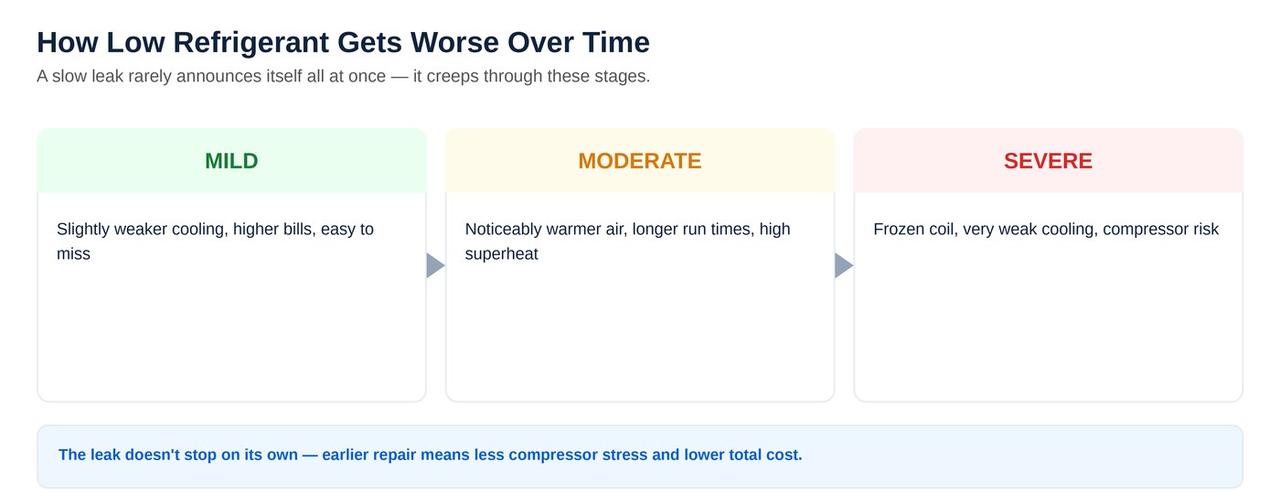
How Low Refrigerant Gets Worse Over Time
Which Refrigerant Problem Is It?
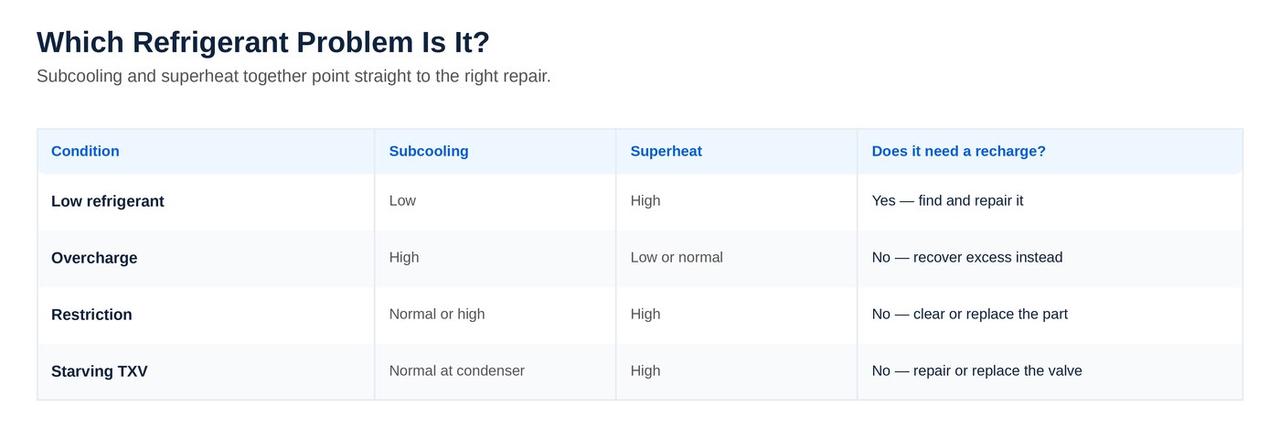
Low refrigerant is easy to confuse with a restriction or a starving TXV, since all three can raise superheat and reduce cooling. Subcooling is usually the clearest differentiator — it runs low with an actual undercharge, but stays normal or high with a restriction or overcharge.
Read the refrigerant restriction guide. · Read the overcharge guide. · Read the TXV problems guide.
How a Technician Confirms Low Refrigerant
- Measure suction and liquid pressures
- Calculate superheat and subcooling
- Compare readings with manufacturer targets
- Inspect for oil residue at fittings and coils
- Sweep with an electronic leak detector
- Use UV dye or a nitrogen pressure test if needed
- Confirm refrigerant type before recharging
- Weigh in refrigerant to the correct charge after repair
How Low Refrigerant Is Repaired
- Locate the leak using appropriate detection methods
- Repair the leaking fitting, joint, valve, or coil
- Recover any remaining refrigerant before repair when required
- Evacuate the system to remove air and moisture
- Recharge to the manufacturer-specified weight
- Verify superheat, subcooling, and performance after the repair
Repair or Replace?
Most low-refrigerant leaks at joints, valves, and fittings are repairable. A leaking evaporator or condenser coil is a bigger repair, and full-system replacement becomes more relevant on an older, out-of-warranty system, especially one still using an outdated refrigerant.
Suspect Low Refrigerant in Spring or The Woodlands?
AC Repair Expo Heating & Cooling Inc provides refrigerant charge diagnostics and leak repair throughout Spring, The Woodlands, Tomball, Cypress, Conroe, Humble, Kingwood, and nearby North Houston.
- Superheat and subcooling testing
- Electronic and UV dye leak detection
- Coil and fitting repair
- Proper evacuation and recharge
- Full refrigerant-circuit diagnosis
Frequently Asked Questions
What are the signs of low refrigerant?
Common signs include weak or warm airflow, ice on the coil or lines, high superheat, hissing sounds, long run times, and rising electric bills.
Does refrigerant get used up over time?
No. A properly sealed system does not consume refrigerant. Low charge means it has leaked out.
Can I just add more refrigerant?
Topping off without repairing the leak is temporary. The refrigerant will leak out again.
Can low refrigerant freeze the coil?
Yes. Low suction pressure can drop evaporator temperature below freezing.
Does low refrigerant raise electric bills?
Yes. An undercharged system runs longer and less efficiently to produce less cooling.
How is low refrigerant confirmed?
Technicians measure superheat and subcooling and compare them with manufacturer targets, then search for the leak.
Can low refrigerant look like a restriction?
Yes. Both can raise superheat, but subcooling and a leak search help tell them apart.
Is low refrigerant dangerous to run?
It can stress the compressor and worsen icing, so it should be addressed rather than run indefinitely.
How much does a leak repair cost?
Cost varies by leak location, from a simple fitting repair to a full coil replacement.
Can a small leak get bigger?
Yes. Vibration, corrosion, and thermal cycling can turn a small leak into a larger one over time.
Should I wait to repair a low-refrigerant system?
Waiting usually means the symptoms get worse and the compressor sees more stress.
When should I call an HVAC technician?
Call when cooling is weak, you notice ice or frost, or the system has needed refrigerant added more than once.