
AC TXV Problems: Symptoms, Diagnosis & Repair
A thermostatic expansion valve (TXV) meters refrigerant into the evaporator based on temperature and pressure feedback. A failing TXV can starve the evaporator of refrigerant or flood it with too much, and the symptoms for each failure mode are very different.
TXV problems are frequently confused with low refrigerant, restrictions, or airflow issues. Correct diagnosis requires more than a single pressure reading.
Texas HVAC License TACLB43277C.
What This Guide Covers
How a TXV Works
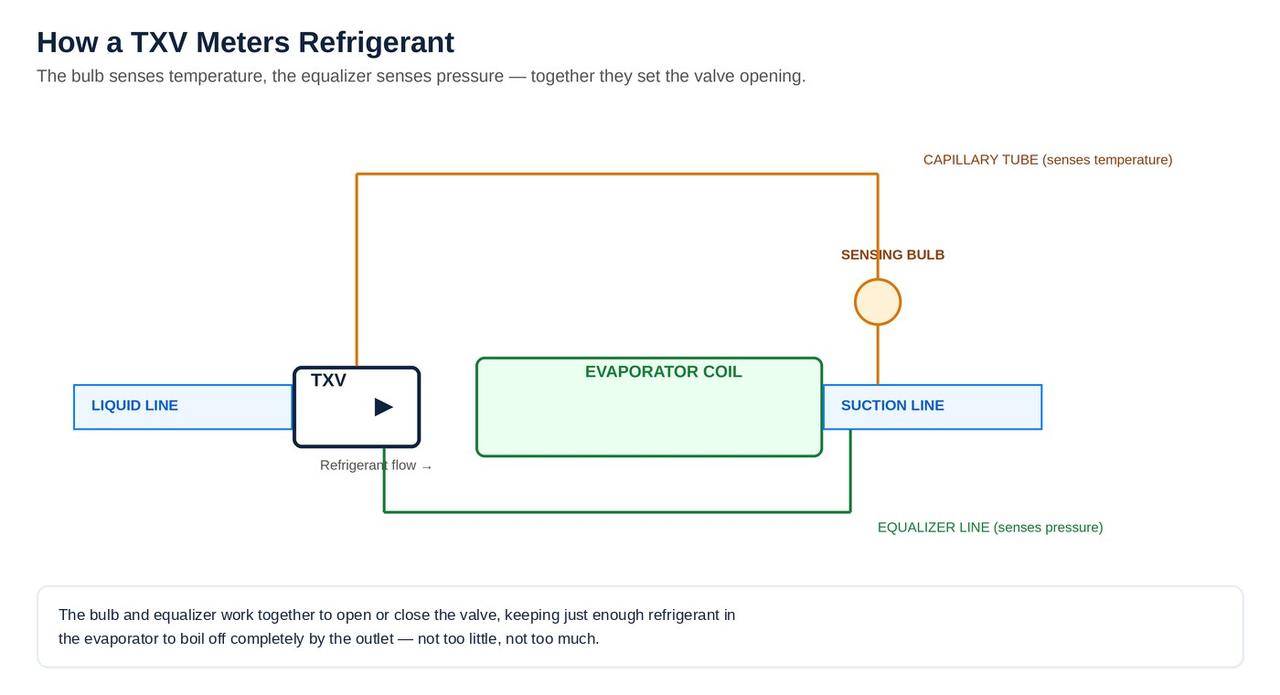
The TXV uses a sensing bulb on the suction line and an equalizer connection to modulate refrigerant flow into the evaporator, targeting a consistent superheat as load and conditions change.
How a TXV Can Fail Two Opposite Ways
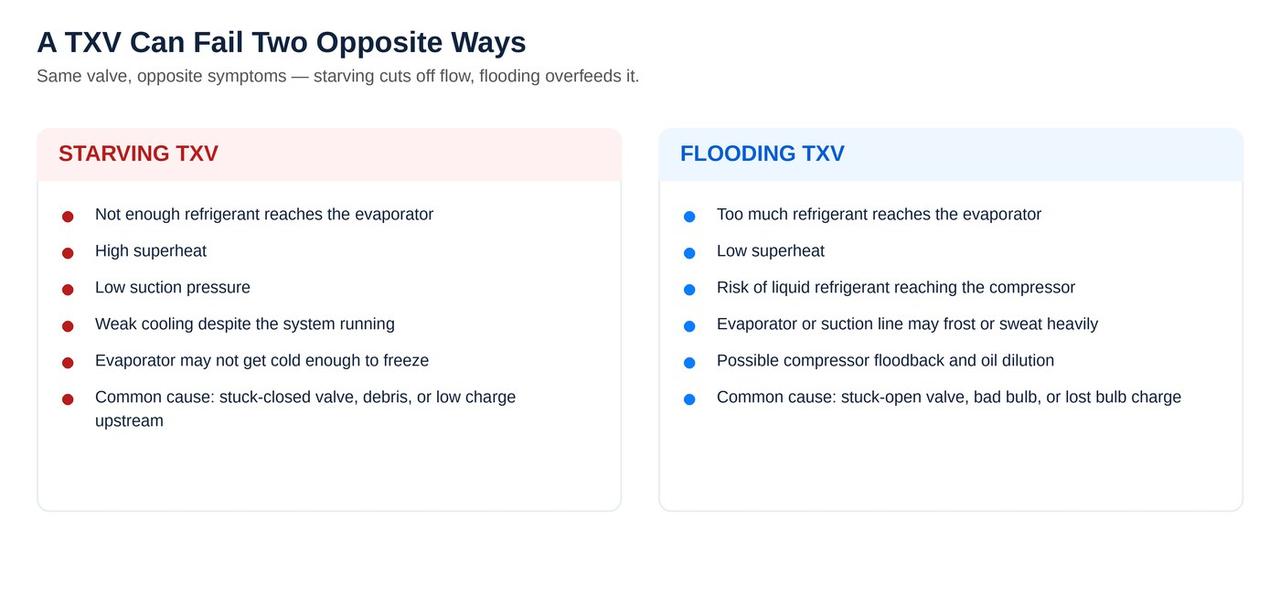
Symptoms of a Starving TXV
High Superheat
Not enough refrigerant reaches the evaporator to satisfy the load.
Low Suction Pressure
Reduced mass flow lowers pressure on the low side.
Weak Cooling
The evaporator can't absorb enough heat to cool the home effectively.
Warm Supply Air
Supply air temperature may stay higher than expected.
Long Run Times
The system struggles to satisfy the thermostat.
Possible Partial Icing
Uneven refrigerant distribution can create localized frost.
Symptoms of a Flooding TXV
Low Superheat
Too much refrigerant leaves the evaporator only partially boiled.
Suction Line Frost or Heavy Sweating
Liquid refrigerant traveling further down the suction line can cause frost well past the evaporator.
Compressor Floodback Risk
Liquid refrigerant may return toward the compressor and dilute oil.
Noisy Compressor Operation
Liquid slugging can create knocking or unusual sounds.
Reduced Compressor Life
Repeated floodback can damage bearings, valves, and windings over time.
Inconsistent Cooling
Overfeeding can create uneven performance despite adequate charge.
Sensing Bulb and Equalizer Problems
- Loose or poorly insulated sensing bulb
- Bulb mounted in the wrong position on the suction line
- Lost or degraded bulb charge
- Damaged or kinked equalizer line
- Internal or external equalizer confusion during service
- Contamination or debris affecting valve movement
TXV vs. Piston Metering Device
| Clue | TXV | Fixed-orifice piston |
|---|---|---|
| Response to load changes | Actively modulates flow | Does not modulate; relies on pressure differential |
| Superheat behavior | Targets a relatively stable superheat | Superheat varies more with load and charge |
| Common failure mode | Starving or flooding from valve or bulb issues | Wear or debris changing the fixed orifice size |
TXV Problems vs. Low Refrigerant Charge
| Clue | TXV starving | Low refrigerant charge |
|---|---|---|
| Subcooling | May be normal at the condenser | Often low |
| Superheat | High | High |
| Bulb and equalizer condition | May show damage or poor contact | Normal |
| After adding refrigerant | Symptoms may not fully resolve | Symptoms typically improve |
How a Technician Diagnoses a TXV Problem
- Measure suction and liquid pressures
- Calculate superheat and subcooling
- Inspect bulb position, contact, and insulation
- Inspect the equalizer line for damage
- Compare readings against manufacturer targets
- Check for frost pattern and location
- Rule out low charge, restriction, and airflow problems
- Test valve response to load changes when possible
- Inspect for contamination or debris
How TXV Problems Are Repaired
- Reposition and properly insulate the sensing bulb
- Repair or replace a damaged equalizer line
- Replace a TXV with a lost or failed bulb charge
- Clean or replace a valve with debris contamination
- Replace the complete TXV when internally damaged
- Correct refrigerant charge after the valve is repaired
Repair or Replace?
Bulb and equalizer problems are often repairable without replacing the valve. Full TXV replacement becomes necessary when the valve is internally stuck, contaminated, or has lost its charge.
Suspect a TXV Problem in Spring or The Woodlands?
AC Repair Expo Heating & Cooling Inc provides metering-device and refrigerant-circuit diagnostics throughout Spring, The Woodlands, Tomball, Cypress, Conroe, Humble, Kingwood, and nearby North Houston.
- Superheat and subcooling testing
- Sensing bulb and equalizer inspection
- TXV response testing
- Refrigerant charge verification
- Full refrigerant-circuit diagnosis
Frequently Asked Questions
What does a TXV do?
It meters refrigerant into the evaporator based on temperature and pressure feedback to maintain proper superheat.
What are the symptoms of a bad TXV?
Symptoms range from high superheat and weak cooling (starving) to low superheat and floodback risk (flooding), depending on the failure mode.
Can a loose sensing bulb cause TXV problems?
Yes. A loose or poorly insulated bulb can mimic a failed valve without requiring replacement.
Can a TXV problem look like low refrigerant?
Yes. Both can cause high superheat, so subcooling and bulb inspection help distinguish them.
Can a TXV cause compressor damage?
Yes. A flooding TXV can send liquid refrigerant toward the compressor and cause floodback.
Does every metering device use a TXV?
No. Some systems use a fixed-orifice piston instead, which behaves differently under changing load.
Can a TXV be repaired instead of replaced?
Sometimes. Bulb and equalizer issues are often repairable without replacing the entire valve.
How is a TXV problem confirmed?
Technicians measure superheat, subcooling, inspect the bulb and equalizer, and rule out charge and airflow issues.
Can debris cause TXV problems?
Yes. Contamination inside the valve can restrict or stick it open or closed.
Should refrigerant be added to fix TXV symptoms?
Not without confirming the cause. Adding refrigerant to a TXV problem may not resolve the symptoms and can create a new issue.
Is TXV replacement expensive?
Cost varies by system and accessibility, but it is generally a moderate refrigerant-circuit repair.
When should I call an HVAC technician?
Call when cooling is weak, frost patterns are unusual, or the compressor shows signs of floodback or noise.