
AC Humming but Won't Start
A humming outdoor unit that won't start is one of the most common AC complaints, and the cause is disproportionately electrical rather than a failed compressor. A weak run capacitor alone accounts for the majority of these calls.
The sound doesn't tell you which part failed — a capacitor, a contactor, low voltage, a locked rotor, and true compressor winding damage can all produce a very similar hum.
Texas HVAC License TACLB43277C.
What This Guide Covers
Most Likely Causes, Ranked
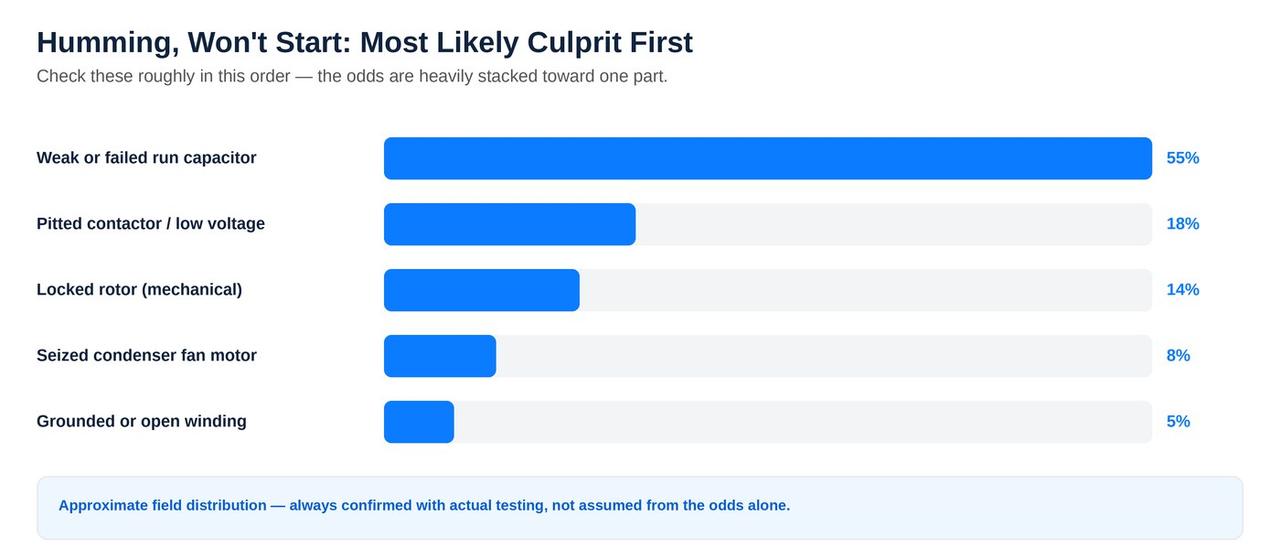
These figures reflect general field experience, not a guarantee for any specific system — but they explain why a capacitor test is always the first move, not the last resort.
Why a Bad Capacitor Is the Most Common Cause
The run capacitor gives the compressor motor the electrical push it needs to start turning. When it weakens below its rated microfarad value, the motor can't develop enough torque to start — it just hums under load until the internal thermal overload opens.
- Capacitance tests below its rated value
- Capacitor may be visibly swollen or bulging
- Compressor starts normally once it's replaced
- Very common failure point in Texas heat
Other Causes of Humming Without Starting
Pitted or Chattering Contactor
Burned contacts can prevent full voltage from reaching the compressor even while it hums.
Low Supply Voltage
Insufficient voltage reduces starting torque and current-carrying capacity.
Locked Rotor
A mechanically seized compressor will hum and draw high current without turning.
Seized Condenser Fan
A fan motor that's failed can sometimes be mistaken for compressor humming.
Grounded or Open Winding
Internal compressor winding damage is possible but the least common cause.
High Head Pressure
Starting against excessive discharge pressure can make a healthy compressor struggle to start.
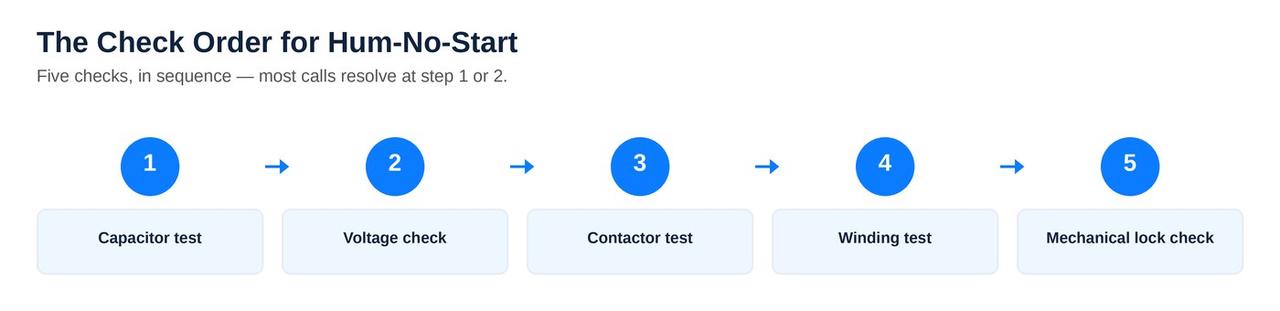
The Check Order
What a Technician Tests
- Run capacitor capacitance versus its rating
- Supply voltage under load
- Contactor coil voltage and contact condition
- Compressor winding resistance
- Insulation to ground
- Startup and running amperage
- Refrigerant pressures, ruling out high head pressure
How Humming, No-Start Problems Are Repaired
- Replace a weak or failed run capacitor
- Repair or replace a pitted contactor
- Correct low voltage or a wiring problem
- Address high head pressure causing hard starting
- Replace the compressor if winding damage or lock is confirmed
Repair or Replace?
Most humming, no-start calls are resolved with a capacitor or contactor repair — inexpensive fixes for the majority of cases. Compressor or system replacement only becomes relevant once testing actually confirms winding damage or a mechanical lock.
AC Humming, Won't Start in Spring or The Woodlands?
AC Repair Expo Heating & Cooling Inc tests capacitors, voltage, contactors, and windings throughout Spring, The Woodlands, Tomball, Cypress, Conroe, Humble, Kingwood, and nearby North Houston before recommending any repair.
- Capacitor and voltage testing
- Contactor inspection
- Winding and ground checks
- Startup amperage testing
- Same-day diagnosis available
Frequently Asked Questions
Why does my AC hum but not start?
The most common cause is a weak or failed run capacitor. Contactor problems, low voltage, and locked rotor conditions are also possible.
Is a humming compressor always a bad compressor?
No. A weak capacitor is the most common cause, and the compressor itself is often fine.
How much does it cost to fix a humming AC?
If it's a capacitor, typically $150–$350. Compressor replacement runs significantly higher.
Can low voltage cause humming without starting?
Yes. Insufficient voltage can reduce starting torque enough to prevent the compressor from turning.
Should I try a hard start kit myself?
No. Installing one without testing the capacitor and voltage first can mask a bigger problem.
Can a bad contactor cause humming?
Yes. Burned or pitted contacts can prevent full voltage from reaching the compressor.
What does it mean if the fan runs but the compressor just hums?
The fan and compressor are separate circuits — this pattern still points toward capacitor, contactor, or compressor testing.
Can I keep trying to restart it myself?
No. Repeated startup attempts add heat and electrical stress without fixing the underlying cause.
How is a locked rotor different from a bad capacitor?
A locked rotor still hums with a good capacitor installed; a capacitor problem resolves once the capacitor is replaced.
Does humming mean the compressor needs replacing?
Not usually. Compressor winding damage is the least common cause on this list.
Can Texas heat make this worse?
Yes. High ambient temperature and long run times accelerate capacitor wear.
When should I call an HVAC technician?
Call as soon as you notice the hum-no-start pattern rather than repeatedly resetting the breaker or forcing restarts.