
AC Compressor Won't Turn On
An AC compressor that won't turn on can mean a lot of different things depending on what the outdoor unit is actually doing — completely silent, humming, or clicking on and off. Each pattern points toward a different part of the system.
This guide covers the full range of no-start scenarios and what to check before calling for service.
Texas HVAC License TACLB43277C.
What This Guide Covers
Silent, Humming, or Clicking — Which Is It?
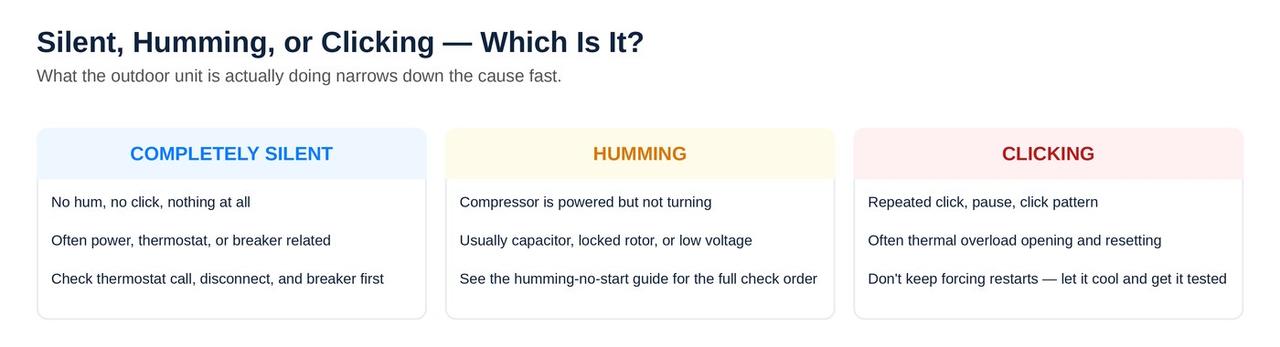
If the unit is humming, the compressor is getting power but can't start turning — see our humming, won't start guide for the full check order on that specific pattern. If it's completely silent, the problem is more likely upstream of the compressor entirely.
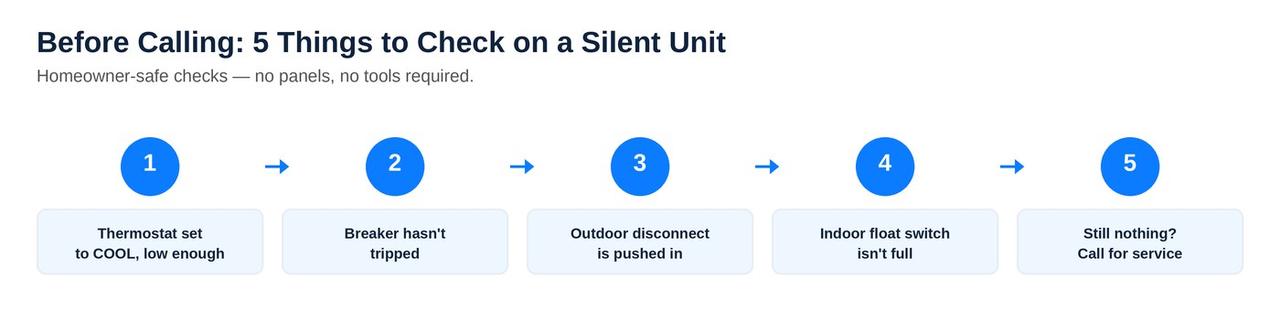
Before Calling: Checks for a Silent Unit
All Possible Causes of a No-Start Compressor
Thermostat Not Calling
Incorrect mode, setpoint, or a dead thermostat battery can prevent the call entirely.
Tripped Breaker
A tripped breaker cuts all power to the outdoor unit.
Disconnect Switch Pulled or Open
The outdoor disconnect must be fully seated for power to reach the unit.
Full Condensate Safety Switch
Many systems shut cooling down automatically when the drain pan float switch trips.
Weak or Failed Capacitor
The most common cause of a humming, no-start compressor.
Pitted or Failed Contactor
A contactor that won't close or won't stay closed prevents power from reaching the compressor.
Low Voltage
Insufficient voltage can prevent the compressor from developing enough starting torque.
Thermal Overload Open
A hot compressor's internal overload can keep it from restarting until it cools.
Locked Rotor
A mechanically seized compressor will hum and draw high current without turning.
Grounded or Open Winding
Internal electrical damage is possible, though it's the least common cause.
What a Technician Tests
- Thermostat call and low-voltage signal
- Breaker and disconnect condition
- Condensate safety switch status
- Run capacitor capacitance
- Contactor coil voltage and contact condition
- Supply voltage under load
- Compressor winding resistance and insulation to ground
- Startup and running amperage
How No-Start Problems Are Repaired
- Correct a thermostat setting or replace batteries
- Reset a tripped breaker after confirming the cause
- Clear a full condensate line and reset the float switch
- Replace a weak run capacitor
- Repair or replace a failed contactor
- Correct low voltage or a wiring problem
- Replace the compressor if winding damage or lock is confirmed
Repair or Replace?
Most no-start problems trace back to a capacitor, contactor, switch, or control issue — all straightforward repairs. Compressor or system replacement only becomes relevant once testing confirms internal winding damage or a mechanical lock.
AC Won't Turn On in Spring or The Woodlands?
AC Repair Expo Heating & Cooling Inc diagnoses no-start AC systems throughout Spring, The Woodlands, Tomball, Cypress, Conroe, Humble, Kingwood, and nearby North Houston, testing every possible cause before recommending a repair.
- Full electrical diagnostic
- Capacitor and contactor testing
- Winding and ground checks
- Same-day service available
- Clear, tested recommendations
Frequently Asked Questions
Why won't my AC compressor turn on?
Causes range from a tripped breaker or thermostat issue to a bad capacitor, contactor, or, less commonly, compressor damage.
What should I check first if the unit is completely silent?
Thermostat setting, breaker, outdoor disconnect, and the indoor condensate safety switch.
What does it mean if it hums but doesn't start?
The compressor is getting power but can't start turning — most often a weak capacitor.
What does clicking on and off mean?
Often a thermal overload opening and resetting as the compressor overheats trying to start.
Can a full condensate pan stop the AC from starting?
Yes. Many systems have a safety float switch that shuts cooling down when the drain pan fills.
Should I keep resetting the breaker?
No. Repeated resets can worsen an underlying electrical problem.
Is it always the compressor?
No. The compressor itself is often fine — capacitors, contactors, and controls are more common causes.
Can low voltage prevent startup?
Yes. Insufficient voltage can reduce starting torque enough to prevent the compressor from turning.
How much does it cost to fix a no-start AC?
It depends on the cause — a capacitor repair is inexpensive, while compressor replacement costs significantly more.
Can I diagnose this myself?
The thermostat, breaker, and disconnect checks are safe to do yourself. Electrical testing should be left to a technician.
Is a silent unit worse than a humming one?
Not necessarily — it just points to a different part of the system, often upstream of the compressor.
When should I call an HVAC technician?
Call as soon as basic checks (thermostat, breaker, disconnect) don't resolve it, rather than continuing to try restarts.