HVAC Static Pressure Guide: What High Pressure Means for Airflow
Static pressure is the resistance your blower works against. When that resistance is too high, an AC system can become noisy, deliver weak airflow, freeze the evaporator coil, overheat a furnace, waste energy, and shorten blower-motor life. This guide explains how technicians measure pressure and how the readings reveal filter, coil, return, supply, duct, grille, and blower problems.
Quick answer
High HVAC static pressure means the blower is pushing or pulling against excessive resistance. The correct diagnosis is not simply “the ducts are bad.” A technician should measure return pressure, supply pressure, total external static pressure, and component pressure drops, then compare those values with the equipment manufacturer’s fan-performance data. The restriction may be a filter, evaporator coil, return grille, undersized duct, crushed flex duct, closed damper, poor transition, or an incorrect airflow setting.
What this guide covers
What HVAC static pressure actually means
Air moving through an HVAC system encounters resistance. The filter media resists airflow. The evaporator coil resists airflow. Every elbow, flex-duct sag, transition, grille, balancing damper, branch fitting, and register adds resistance. Static pressure is the force the blower must overcome to move the required air volume through that path.
Technicians measure this pressure in inches of water column, written as in. w.c. or in. wg. The number by itself is not enough. The measurement location, blower speed, system mode, filter condition, coil condition, cabinet arrangement, and manufacturer rating all matter.
Return-side pressure
Normally measured as a negative value because the blower is pulling air toward itself.
Supply-side pressure
Normally measured as a positive value because the blower is pushing conditioned air into the supply system.
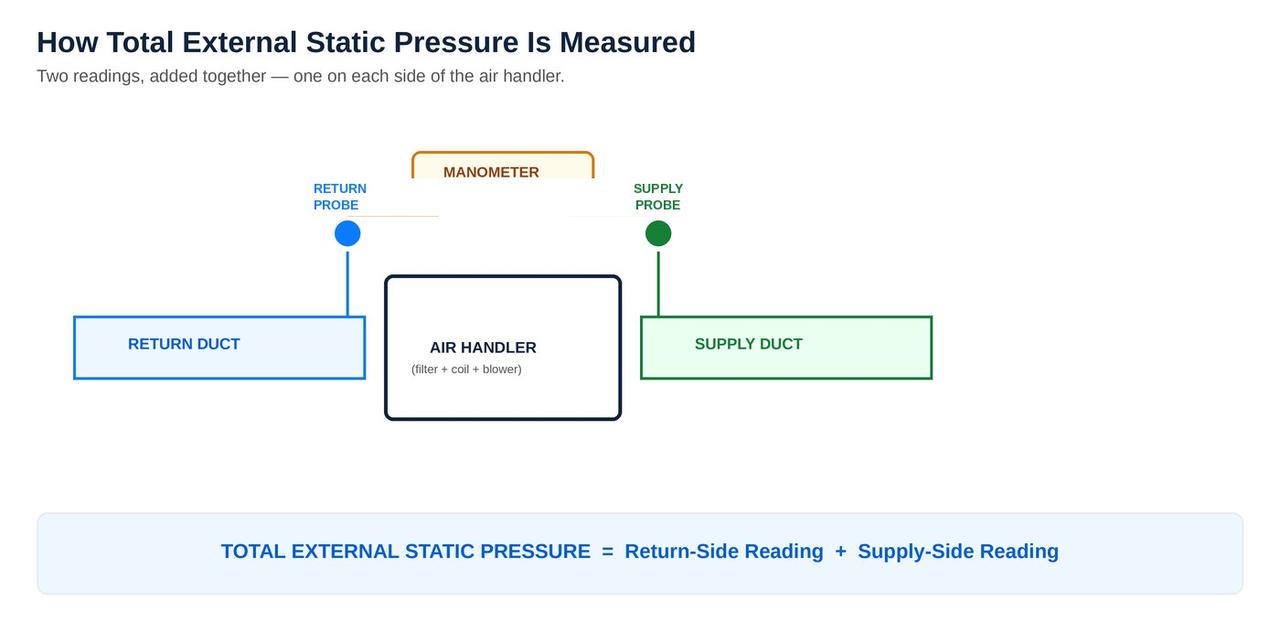
Total external static pressure
The absolute return and supply readings added together at the correct external test locations.
TESP: the HVAC system’s airflow resistance score
Total external static pressure, or TESP, helps show how hard the blower must work against the external air-distribution system and attached components. For a typical draw-through furnace and evaporator-coil arrangement, a technician places probes at the manufacturer-appropriate points, records the negative return pressure and positive supply pressure, and adds their absolute values.
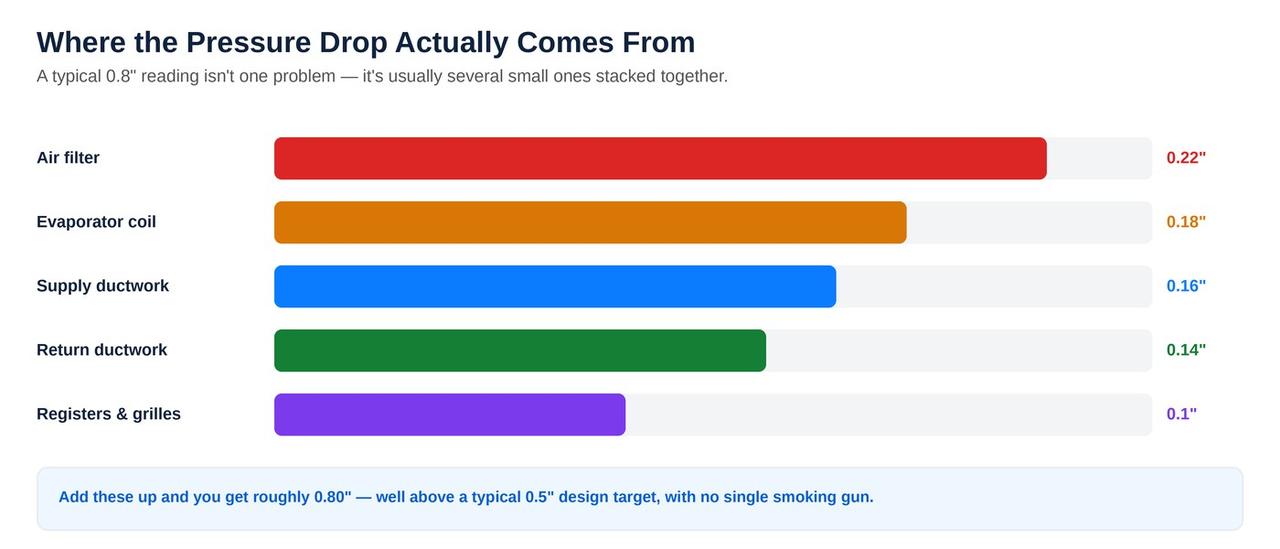
Pressure readings become most useful when they are divided into zones. A high return reading points technicians toward the filter, return grille, return duct, or return transition. A high supply reading points toward the evaporator coil, supply plenum, dampers, supply ducts, registers, or excessive selected airflow.
What is a normal static-pressure reading?
There is no single universal number for every system. Many conventional residential furnaces are commonly evaluated around a maximum external static pressure of 0.50 in. w.c., but some air handlers and variable-speed systems have different ratings. The correct limit is printed in the installation instructions or represented in the manufacturer’s blower-performance tables.
| Reading pattern | What it may indicate | What must be checked next |
|---|---|---|
| High return, moderate supply | Restrictive filter, undersized return, restrictive grille, crushed return flex, poor return transition | Filter drop, grille velocity, return sizing, duct condition, cabinet entry |
| Moderate return, high supply | Dirty coil, closed dampers, undersized supply, restrictive registers, high selected airflow | Coil drop, supply plenum, branch ducts, registers, fan setup |
| Both sides high | Restrictions on both sides, excessive airflow setting, widespread duct-design problem | Full pressure profile and delivered-airflow verification |
| TESP low but airflow weak | Low blower speed, slipping wheel, motor problem, duct leakage, disconnected duct, incorrect test location | Fan table, RPM/command, wheel condition, leakage and airflow testing |
| TESP acceptable but rooms uneven | Distribution or pressure-balancing problem | Branch airflow, room pressure, return paths, balancing and leakage |
Symptoms of high static pressure
Weak airflow
Some or all registers deliver less air than expected, especially at the end of long duct runs.
Whistling and roaring
Restrictive grilles, filters, undersized returns, and high velocities create audible turbulence.
Long cooling cycles
Reduced airflow lowers sensible capacity and can keep the thermostat from reaching its setpoint.
Frozen evaporator coil
Low airflow can lower coil temperature enough for condensation to freeze.
Blower motor stress
ECM blowers may increase speed and power to maintain airflow; PSC blowers often lose airflow as resistance rises.
Furnace limit trips
During heating, insufficient airflow can raise supply temperature and open the high-limit safety.
These symptoms overlap with refrigerant, electrical, thermostat, and equipment-capacity problems. Static pressure is valuable because it replaces guessing with measured evidence.
Common causes of excessive static pressure
1. Restrictive or loaded air filters
A dirty filter can sharply increase resistance, but a clean filter can also be too restrictive if it is undersized or uses dense media in a small cabinet. Technicians should measure the pressure drop across the filter rather than judging only by appearance or MERV rating.
2. Undersized return-air systems
Many homes have one small return grille or a narrow return drop feeding equipment that requires substantially more airflow. The blower then pulls harder, noise increases, and room doors may influence comfort because return paths are inadequate. See our return-air problems guide.
3. Dirty evaporator coils
Dust and biological buildup on the entering-air face of the coil can create a major supply-side pressure drop. The coil may look clean from the accessible side while the blocked surface is hidden. Review dirty evaporator coil symptoms.
4. Duct restrictions and poor transitions
Crushed or kinked flex duct, excessive sag, tight elbows, undersized trunks, abrupt transitions, closed dampers, and restrictive branch fittings all increase resistance. A duct can be sealed yet still be badly sized. Leakage and restriction are different failures, although both can exist together. See duct leakage symptoms.
5. Closed or blocked registers
Closing vents to “push air somewhere else” usually raises pressure and can reduce total airflow. Furniture, rugs, dust-loaded grilles, and decorative registers can also add resistance.
6. Incorrect blower setup
A blower configured above the duct system’s capacity can create high pressure and noise. A blower set too low may produce low static pressure but insufficient airflow. Setup must match equipment capacity, sensible/latent goals, heat-pump requirements, and manufacturer limits.
How a professional static-pressure diagnostic should be performed
- Confirm operating mode and blower stage. Cooling, heating, first stage, second stage, and dehumidification may command different airflow.
- Inspect the system before drilling. The technician identifies the blower, filter, coil, furnace or air-handler configuration, zoning equipment, and safe test locations.
- Use a calibrated manometer and static-pressure probes. Probe orientation and location matter. A random hole or open tubing can produce misleading results.
- Measure return and supply pressure. The readings are recorded with the filter installed and the system operating steadily.
- Calculate TESP. The absolute return and supply values are added and compared with the equipment documentation.
- Measure component drops. Filter, coil, heat exchanger, accessories, and selected duct sections are tested when the pressure profile suggests a restriction.
- Estimate or verify airflow. The measured TESP can be used with the manufacturer fan table, while direct airflow or temperature/psychrometric methods may provide additional confirmation.
- Correct one cause and retest. Replacing a filter, opening a damper, repairing a return, cleaning a coil, or changing setup should produce a measurable improvement.
Component pressure drops: finding the actual restriction
| Component | How it is evaluated | Possible correction |
|---|---|---|
| Filter | Pressure measured immediately before and after the filter | Larger filter area, deeper media cabinet, correct filter, replacement |
| Evaporator coil | Pressure measured on each side of the coil at the operating airflow | Cleaning, correcting airflow, evaluating coil selection or contamination |
| Return grille and duct | Return pressure profile from grille to equipment | Add return capacity, enlarge grille, repair flex, improve transition |
| Supply plenum and trunk | Supply pressure profile across fittings and trunks | Improve transition, enlarge duct, correct dampers and restrictions |
| Registers and branches | Room airflow, branch pressure, velocity and balancing | Repair branch, resize register, balance system, restore return path |
| Accessories | Pressure before and after UV racks, electronic cleaners, humidifiers or dampers | Clean, repair, relocate, resize or remove unnecessary restriction |
How high static pressure affects ECM and PSC blower motors
A traditional PSC blower generally delivers less airflow as static pressure rises. A constant-torque or constant-airflow ECM may increase torque, RPM, and watt draw in an attempt to maintain its programmed airflow. That is why an ECM system can sound extremely loud and still have a duct restriction.
High pressure can contribute to motor overheating, module stress, noise, elevated power consumption, poor dehumidification, and premature failure. Replacing the motor without correcting the restriction is incomplete. Read our ECM blower motor guide and blower motor troubleshooting guide.
Static pressure, airflow and refrigerant diagnosis
Refrigerant readings cannot be interpreted correctly without adequate airflow. Low indoor airflow can reduce suction pressure, lower coil temperature, increase superheat in some situations, contribute to icing, and imitate a refrigerant or metering-device problem. High airflow can reduce dehumidification and alter temperature split.
Before condemning a compressor, TXV, evaporator coil, or refrigerant charge, the technician should verify filter condition, blower operation, static pressure, airflow, and coil cleanliness. Related resources include airflow testing, weak airflow from vents, evaporator coil freezing, and the AC Diagnostic Center.
Repair the airflow system or replace the HVAC equipment?
Static-pressure problems are often repairable without replacing the outdoor unit or entire HVAC system. Enlarging a return, adding filter surface area, repairing crushed flex duct, improving a transition, cleaning a coil, correcting blower setup, or replacing restrictive grilles can produce a major improvement.
Replacement deserves consideration when the equipment is old, oversized, repeatedly failing, mismatched, or paired with a duct system that would require major reconstruction anyway. Variable-speed equipment is not a cure for undersized ducts. A premium blower can expose the problem by becoming louder and using more power.
| Repair is usually favored when | Replacement may be reasonable when |
|---|---|
| Equipment is reliable and correctly sized | Equipment is old, oversized or chronically unreliable |
| The restriction is localized and accessible | Multiple major components and ducts require replacement |
| Measured correction restores airflow | Required airflow cannot be achieved within equipment limits |
| Motor and coil remain healthy | Motor, coil, heat exchanger or compressor also has major damage |
Need a measured airflow diagnosis in North Houston?
AC Repair Expo Heating & Cooling Inc serves Spring, The Woodlands, Tomball, Cypress, Conroe, Humble, Kingwood, and nearby North Houston communities. We can evaluate filters, coils, blower performance, static pressure, duct restrictions, return capacity, temperature split, refrigeration performance, and system operation before recommending repair or replacement.
Call 832-479-2727 or book online. Texas HVAC License TACLB43277C. Address: 1827 Riley Fuzzel Rd Suite C, Spring, TX 77386.
HVAC static pressure FAQs
What is HVAC static pressure?
HVAC static pressure is the resistance the blower must overcome to move air through the filter, coil, supply ducts, registers, return ducts, and grilles. Technicians measure it in inches of water column using a manometer.
What is total external static pressure?
Total external static pressure, often shortened to TESP, is the sum of the measured return-side and supply-side pressures outside the air-moving equipment. It is compared with the manufacturer's rated maximum external static pressure for that exact furnace or air handler.
Is 0.5 inches of water column always the correct limit?
No. Many residential furnaces are rated around 0.50 inches of water column, but air handlers, communicating systems, and specific fan tables may use different limits. The correct target comes from the equipment data and blower-performance table, not a universal rule.
What causes high static pressure in an HVAC system?
Common causes include restrictive or dirty filters, undersized return ducts, closed or blocked registers, dirty evaporator coils, undersized supply ducts, crushed flex duct, poor transitions, restrictive grilles, dampers, and excessive blower airflow.
Can high static pressure cause weak airflow?
Yes. High resistance can reduce delivered airflow, especially with permanent-split-capacitor blower motors. ECM motors may try to maintain airflow by increasing speed and power, which can create noise, high energy use, and motor stress.
Can a dirty filter raise static pressure?
Yes. A loaded or overly restrictive filter can create a large pressure drop. The filter should be evaluated by measuring pressure before and after it while the system is operating at the relevant blower speed.
Can high static pressure freeze an evaporator coil?
It can contribute. If excessive resistance lowers airflow across the evaporator coil, the coil temperature can fall below freezing. Refrigerant charge, metering-device operation, blower performance, and coil cleanliness must also be checked.
Why are some rooms still hot when total static pressure looks acceptable?
TESP describes overall system resistance, not room-by-room air distribution. Branch restrictions, balancing problems, leakage, disconnected ducts, pressure imbalances, or insufficient return paths can still leave individual rooms uncomfortable.
How do technicians measure static pressure?
A technician uses a calibrated digital manometer and properly placed static-pressure probes. Measurements may include return static, supply static, TESP, filter pressure drop, coil pressure drop, and duct-system pressure at selected locations.
Does closing supply vents save energy?
Usually not. Closing several vents increases system resistance and can reduce airflow, increase noise, raise blower energy, and worsen coil or furnace temperature problems. Zoning requires properly designed dampers, controls, bypass strategy when applicable, and verified airflow.
Can replacing an ECM blower motor fix high static pressure?
Not by itself. A new motor may restore operation, but the duct, filter, coil, grille, or setup problem that created excessive resistance must be corrected or the replacement motor can remain noisy, inefficient, or short-lived.
Should I repair the duct system or replace the HVAC equipment?
Repair the airflow defect when the equipment is otherwise sound and correctly sized. Replacement may make sense when the system is old, mismatched, oversized, repeatedly failing, or unable to meet airflow requirements even after reasonable duct improvements. A measured diagnosis should guide the decision.