
Duct Leakage Symptoms
Leaky ductwork is one of the most common — and most invisible — reasons a Texas AC system runs constantly but never quite keeps up. Ducts running through a hot attic can lose a significant share of conditioned air before it ever reaches a room.
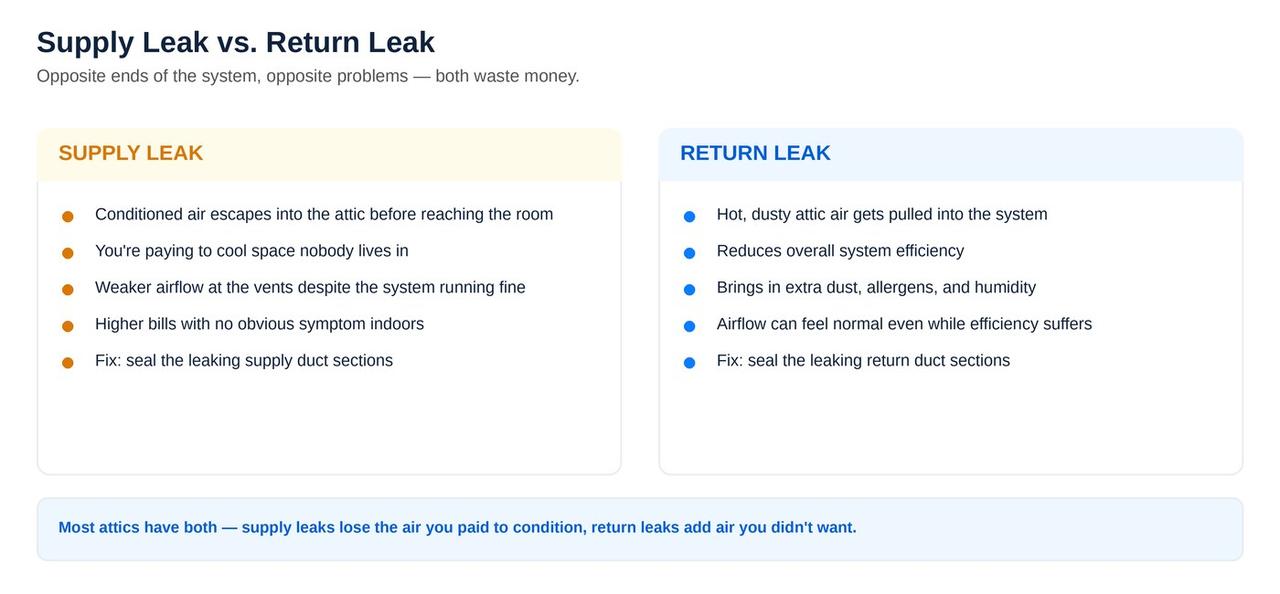
The symptoms depend on where the leak is: a leak on the supply side wastes conditioned air, while a leak on the return side pulls in the wrong air entirely.
Texas HVAC License TACLB43277C.
What This Guide Covers
Symptoms of Duct Leakage
Higher Energy Bills
Conditioned air lost to the attic is air you paid to cool but never got to use.
Weak Airflow at Some Vents
Rooms fed by a leaking duct run get less air than rooms on a sealed run.
Uneven Room Temperatures
Some rooms cool fine while others consistently lag behind.
Dusty Smell or Higher Allergens
A return-side leak pulls attic dust directly into the airstream.
Long Run Times
The system runs longer trying to compensate for lost conditioned air.
Attic Feels Cooler Than It Should
A significant supply leak can be felt as cool air escaping near duct connections.
Supply Leak vs. Return Leak
Where Ductwork Actually Leaks
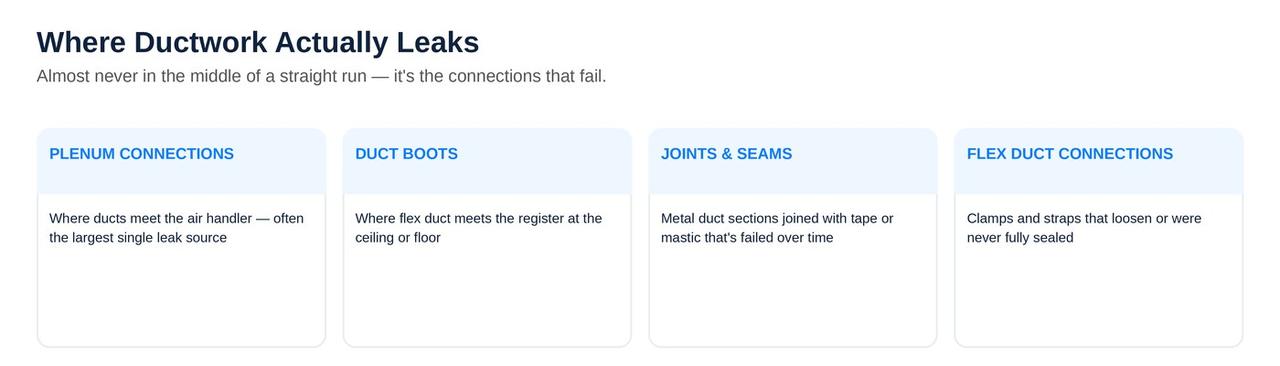
Straight sections of duct rarely fail on their own. It's almost always a connection — where two pieces meet, where a boot connects to a register, or where a clamp has loosened over years of attic heat cycling.
How a Technician Diagnoses Duct Leakage
- Visually inspect accessible ductwork for gaps and disconnected sections
- Measure static pressure to identify abnormal resistance patterns
- Compare airflow room by room
- Check for temperature differences between rooms on different duct runs
- Perform a duct leakage test where more precision is needed
How Duct Leaks Are Repaired
- Seal accessible joints and seams with mastic or approved tape
- Reconnect and secure disconnected duct sections
- Replace or reseal failing duct boots
- Tighten or replace loose clamps on flex duct connections
- Insulate repaired sections to prevent condensation and heat gain
Repair or Replace?
Most duct leaks are repairable by sealing the specific failed connections. Full duct replacement becomes more relevant when ductwork is old, undersized, or damaged extensively enough that patch repairs won't hold up.
Suspect Duct Leaks in Spring or The Woodlands?
AC Repair Expo Heating & Cooling Inc inspects and seals ductwork throughout Spring, The Woodlands, Tomball, Cypress, Conroe, Humble, Kingwood, and nearby North Houston.
- Full ductwork inspection
- Static pressure testing
- Room-by-room airflow comparison
- Joint and boot sealing
- Honest, tested recommendations
Frequently Asked Questions
What are the symptoms of duct leakage?
Higher energy bills, weak or uneven airflow, dusty smells, long run times, and rooms that never quite cool down.
How do I know if I have a supply or return leak?
A supply leak typically shows up as weak airflow and higher bills; a return leak often shows up as dust, allergens, or reduced efficiency with airflow that still feels normal.
Where do ducts usually leak?
Almost always at connections — plenum joints, duct boots, seams, and flex duct clamps — rather than in the middle of a straight run.
Can duct leaks raise my electric bill?
Yes. Conditioned air lost before reaching the room is air you paid to cool with nothing to show for it.
Can duct leaks cause uneven cooling?
Yes. Rooms on a leaking duct run often cool noticeably worse than rooms on sealed runs.
How are duct leaks found?
Technicians visually inspect accessible ductwork, check static pressure patterns, and can perform a duct leakage test for precision.
Can I seal duct leaks myself?
Basic accessible tape repairs are sometimes homeowner-safe, but a full seal, especially on hard-to-reach sections, is best left to a technician.
How much conditioned air can leaky ducts waste?
It varies by system, but leaks in an attic running through Texas summer heat can waste a meaningful share of total cooling output.
Do return leaks affect indoor air quality?
Yes. They can pull in attic dust, insulation fibers, and humidity directly into the airstream.
Is duct sealing expensive?
Sealing specific leaking connections is generally affordable compared with the ongoing energy cost of leaving leaks unaddressed.
Can old ductwork develop more leaks over time?
Yes. Tape and mastic degrade, and clamps loosen with repeated heat cycling in the attic.
When should I call an HVAC technician?
Call if bills are climbing without explanation, some rooms consistently underperform, or you notice a dusty smell when the system runs.