Return Air Problems: Symptoms, Causes and HVAC Fixes
Your HVAC blower cannot deliver conditioned air unless the same volume of air can return to the furnace or air handler. Undersized return ducts, restrictive filters, blocked grilles, leaky attic returns, closed bedroom doors, and poor return pathways can create weak airflow, loud suction, hot rooms, high static pressure, coil icing, and unnecessary equipment stress.
Quick answer
A return air problem means the blower cannot receive air freely, evenly, or cleanly from the house. The right diagnosis requires more than looking at grille size. A technician should measure return static pressure, total external static pressure, filter pressure drop, blower airflow, room pressure with doors closed, and duct leakage. The repair may involve a larger return, additional return paths, a less restrictive filter arrangement, duct sealing, grille replacement, or correction of blower setup.
In this guide
Signs your HVAC system may have a return air problem
Loud return grille
Whistling, roaring, or strong suction often means too much airflow is being forced through too little free area or a restrictive filter.
Weak supply airflow
The blower cannot push full airflow into the supply system when it is starved on the return side.
Uneven temperatures
Rooms without a return path may become pressurized when doors close, reducing supply delivery and creating hot or cold zones.
Filter movement
A filter that bows, whistles, or pulls hard against the rack may be seeing excessive face velocity or pressure drop.
Coil icing
Low airflow can allow the evaporator coil to fall below freezing, although refrigerant and blower faults must also be ruled out.
Blower stress
An ECM blower may speed up and use more power; a PSC blower may simply deliver less air as resistance rises.
These symptoms overlap with dirty coils, duct restrictions, blower faults, refrigerant problems, and incorrect equipment sizing. That is why measured testing matters. See our guides to weak airflow from AC vents, HVAC static pressure, and professional airflow testing.
Common causes of return air restrictions
| Cause | What it does | Typical evidence | Likely correction |
|---|---|---|---|
| Undersized return duct or plenum | Creates high negative pressure and limits blower inlet airflow | Loud return, high return static, weak supply airflow | Resize or add a properly designed return path |
| Restrictive or dirty filter | Adds pressure drop before the blower | Filter bowing, large measured filter drop, airflow improves without restriction | Correct filter size, rack, media area, and replacement interval |
| Blocked return grille | Reduces effective grille area | Furniture, curtains, rugs, boxes, heavy dust loading | Clear obstruction or relocate/resize grille |
| Crushed or collapsed flex duct | Reduces cross-sectional area | Kinks, tight bends, sagging, compression, high localized pressure | Repair or replace duct and support correctly |
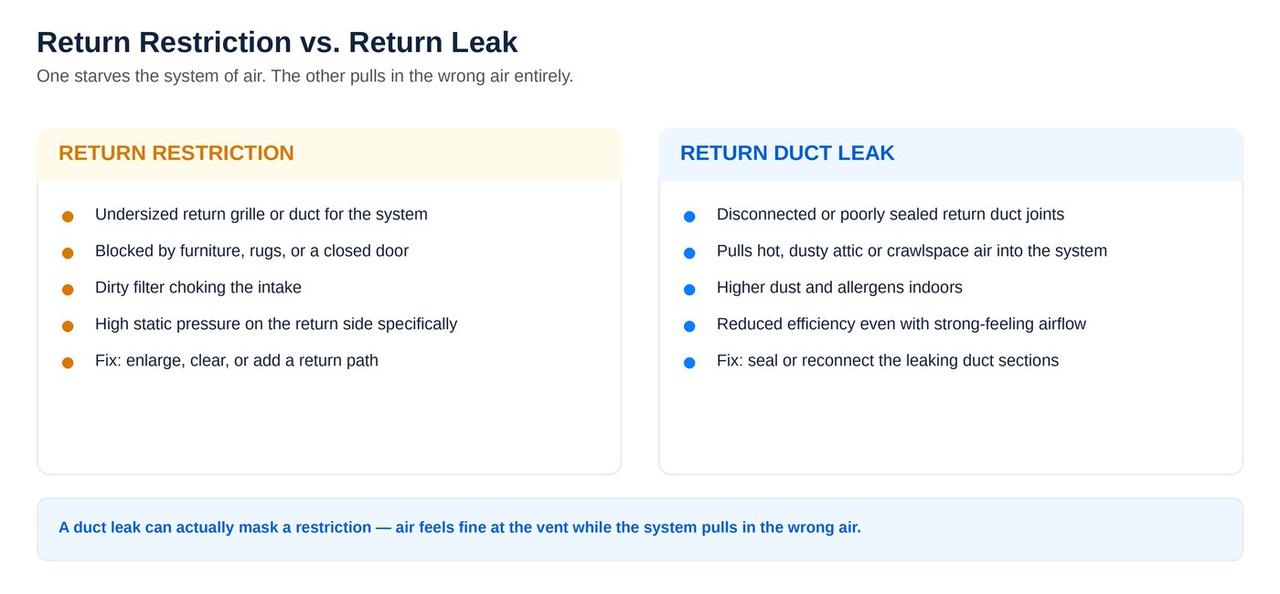
| Leaky return in attic or garage | Pulls hot, humid, dusty, or contaminated air into the system | Dust streaks, high humidity, capacity loss, duct leakage test failure | Seal with approved materials and repair damaged duct |
| No return path from closed rooms | Pressurizes rooms and reduces supply airflow | Door movement, comfort changes with door open, room pressure difference | Dedicated return, jump duct, transfer grille, or engineered pathway |
| Oversized equipment or excessive blower setting | Demands more airflow than the return can handle | High noise, short cycles, poor humidity control, high static | Correct airflow setup, duct redesign, or equipment right-sizing |
How return air restrictions affect static pressure and blower performance
The return side of an operating HVAC system is under negative pressure relative to the surrounding space. A technician measures that pressure with a manometer and combines it with supply pressure to calculate total external static pressure. The result must be compared with the exact furnace or air-handler rating and fan-performance table.
Return pressure by itself does not prove the exact defect. The technician may need pressure measurements before and after the filter, across the indoor coil, and at selected duct locations. A restrictive filter, small return drop, undersized grille, blocked duct, or poorly shaped transition can each produce a different pressure pattern.
High return resistance can also distort refrigerant diagnosis. Low airflow changes coil temperature, suction pressure, superheat, temperature split, and dehumidification. Airflow should be verified before a technician condemns a TXV, compressor, evaporator coil, or refrigerant charge. Review why evaporator coils freeze and TXV problem symptoms.
Closed bedroom doors and missing return pathways
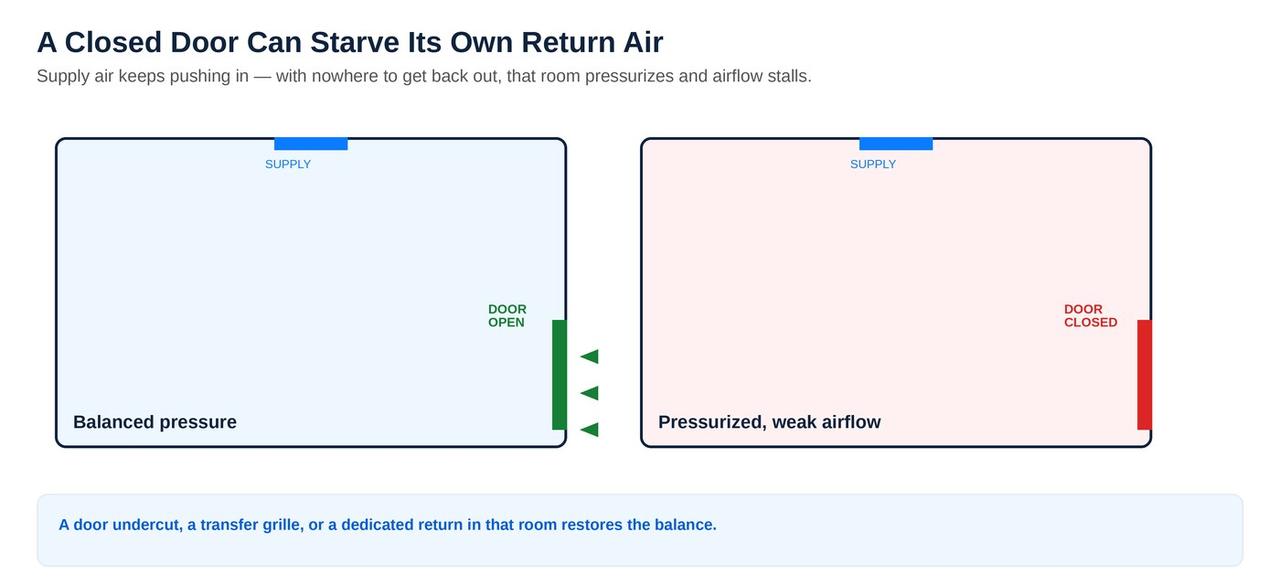
A supply register pushes air into a bedroom. That air must leave the room and return to the central system. When the door is closed and the room lacks a dedicated return or adequate transfer path, the room can become positively pressurized. Supply airflow may fall, comfort worsens, and conditioned air may be forced through leaks in the building envelope.
At the same time, the central area can become negatively pressurized, pulling outdoor air through cracks and increasing humidity. This is especially important in North Houston, where attic and outdoor air can be extremely hot and humid.
| Return-path option | Best use | Important design point |
|---|---|---|
| Dedicated room return | Bedrooms and closed rooms with meaningful supply airflow | Must connect to a properly sized return system |
| Jump duct | Transfer between room and hall/central area | Size for low pressure and control sound/light transfer |
| Transfer grille | Wall or door-adjacent pressure relief | Must provide enough free area and address privacy/noise |
| Door undercut | Small airflow requirements | Often inadequate for higher-airflow rooms; verify by pressure testing |
ENERGY STAR guidance treats room pressure balance as a measurable design issue, not a guess. A technician or rater can compare room pressure with the main body of the house while the air handler operates and doors are closed.
Return duct leaks can pull attic air, dust and humidity into the system
Supply leaks push conditioned air out. Return leaks pull surrounding air in. A leak in an attic return can draw 120°F attic air, insulation fibers, dust, and humidity into the air handler. A garage-side return leak can create an indoor-air-quality and safety concern. Building cavities used as returns can also be difficult to seal and may connect to unwanted spaces.
Common leak points include return plenums, filter racks, platform returns, panned joists, disconnected flex duct, cabinet seams, access panels, and poorly sealed boots. The correct repair uses approved duct-sealing materials such as mastic or listed systems—not cloth-backed “duct tape” as a permanent fix.
For more detail, see duct leakage symptoms and HVAC ductwork life expectancy.
Filters, return grilles and free area
A filter can be clean and still be too restrictive for the available surface area and airflow. High-efficiency media is useful only when the rack and return design can support it. Installing a dense one-inch filter in a small return may create a much larger pressure drop than a properly sized media cabinet with greater surface area.
What a technician should check
- Filter dimensions, depth, condition, orientation, and fit
- Measured pressure drop across the filter at operating airflow
- Return grille free area rather than face dimensions alone
- Filter rack leakage and bypass around the filter
- Whether multiple returns share enough total area
- Whether the blower speed is appropriate for the equipment and duct system
Removing the filter temporarily may change pressure and airflow, but it is not a permanent operating solution. The system needs filtration and the correct amount of filter surface area.
Professional return air diagnostic sequence
- Confirm the complaint. Check airflow, noise, room temperatures, humidity, door effects, and operating mode.
- Inspect the return path. Examine grilles, filters, racks, plenums, ducts, fittings, flex compression, and cabinet connections.
- Measure pressure. Record return static, supply static, TESP, filter drop, and other component drops where appropriate.
- Verify blower setup. Confirm motor operation, speed taps or programmed airflow, equipment size, and manufacturer fan data.
- Measure delivered airflow. Use appropriate methods such as fan-table interpretation, flow hood readings, pressure matching, or other calibrated testing.
- Test room pressure balance. Evaluate closed bedrooms and other isolated rooms.
- Check leakage. Inspect and test return ducts, plenums, filter racks, and platform returns.
- Evaluate the indoor coil and refrigerant circuit. Only after airflow is understood should refrigerant readings be interpreted.
- Document repair options. Explain measured defects, expected improvement, and whether duct modification or equipment changes are justified.
This sequence prevents expensive misdiagnoses such as replacing an ECM blower motor when the real problem is an undersized return, or adding refrigerant when low airflow is causing abnormal coil conditions. Related guides: ECM blower motors, blower troubleshooting, and the AC Diagnostic Center.
Repair the return system or replace the HVAC equipment?
Many return-air defects can be corrected without replacing the entire HVAC system. Practical repairs include enlarging a return drop, adding a second return, installing a larger media filter cabinet, correcting flex duct routing, sealing leakage, adding room return pathways, replacing a restrictive grille, or adjusting blower airflow after testing.
| Repair is usually favored when | Replacement may be reasonable when |
|---|---|
| The equipment is reliable and correctly sized | The equipment is old, oversized, mismatched, or repeatedly failing |
| The return defect is accessible and measurable | Major duct reconstruction and major equipment repairs are both required |
| Correcting the return restores airflow within published limits | The system cannot meet airflow needs within manufacturer limits |
| The indoor coil, blower, compressor, and heat exchanger remain healthy | Multiple major components are damaged or obsolete |
Do not assume variable-speed equipment will solve bad ducts. An ECM blower may work harder against restriction, increasing noise and motor stress. Equipment selection and duct design must work together.
Return air diagnostics in Spring and North Houston
AC Repair Expo Heating & Cooling Inc serves Spring, The Woodlands, Tomball, Cypress, Conroe, Humble, Kingwood, and nearby North Houston communities. We can evaluate return capacity, static pressure, filters, grilles, duct leakage, room pressure balance, blower performance, evaporator-coil condition, and refrigerant operation before recommending repair or replacement.
Call 832-479-2727 or book online. Texas HVAC License TACLB43277C. Address: 1827 Riley Fuzzel Rd Suite C, Spring, TX 77386.
Return air problems FAQs
What does the return air system do?
The return air system gives room air a path back to the furnace or air handler so the blower can move it across the filter and indoor coil, then redistribute conditioned air through the supply ducts.
What are common signs of a return air problem?
Common signs include loud suction at return grilles, weak airflow from supply vents, doors that move or become difficult to close, hot or cold rooms, dust near return leaks, filter bowing, high static pressure, coil icing, and unusually high blower noise.
Can an HVAC system have too little return air?
Yes. A return grille, filter rack, return plenum, or duct system can be too small or too restrictive for the airflow the equipment needs. The diagnosis should be based on measured return pressure, total external static pressure, filter pressure drop, and delivered airflow.
Will adding another return grille fix weak airflow?
Sometimes, but only when the new grille and duct provide a low-resistance path to the blower. Adding a grille to an already undersized trunk or connecting it poorly may provide little improvement. The entire return path must be evaluated.
Can a dirty filter cause return air problems?
Yes. A loaded or overly restrictive filter increases pressure drop on the return side. That can reduce airflow, increase blower effort, create noise, and contribute to coil icing or furnace temperature-limit problems.
Can a return duct leak pull attic air into the system?
Yes. Return ducts operate under negative pressure, so leaks in an attic, garage, wall cavity, or crawlspace can pull hot, humid, dusty, or contaminated air into the HVAC system. This can reduce capacity and worsen indoor air quality.
Why does closing a bedroom door make the room uncomfortable?
If the room has supply airflow but no adequate return path, closing the door can pressurize the room and reduce supply delivery. The rest of the house may become depressurized. A dedicated return, transfer grille, jump duct, or correctly sized door undercut may be needed.
Can return air problems freeze the evaporator coil?
Yes. Excessive return restriction can reduce airflow across the evaporator coil and allow the coil temperature to fall below freezing. Refrigerant charge, blower operation, coil cleanliness, and metering-device performance must also be checked.
Should return grilles be blocked by furniture?
No. Furniture, rugs, curtains, boxes, and filter media that cover or crowd a return grille can increase resistance and reduce airflow. Keep the grille face and the area immediately in front of it clear.
Is one central return enough for a whole house?
It can be, but only if the central return is properly sized and rooms have reliable return-air pathways when doors are closed. Many homes need dedicated returns, transfer grilles, jump ducts, or other pressure-balancing measures.
Can an oversized AC cause return air noise?
Yes. Oversized equipment often requires high airflow through ducts that were not designed for it. The result can be loud grilles, high static pressure, short cycling, poor humidity control, and blower stress.
Should I repair the return system or replace the HVAC equipment?
Repair the return defect when the equipment is otherwise healthy and correctly sized. Replacement may make sense when the system is old, oversized, mismatched, repeatedly failing, or cannot operate within manufacturer airflow limits even after practical duct improvements.