
Outside AC Fan Not Spinning
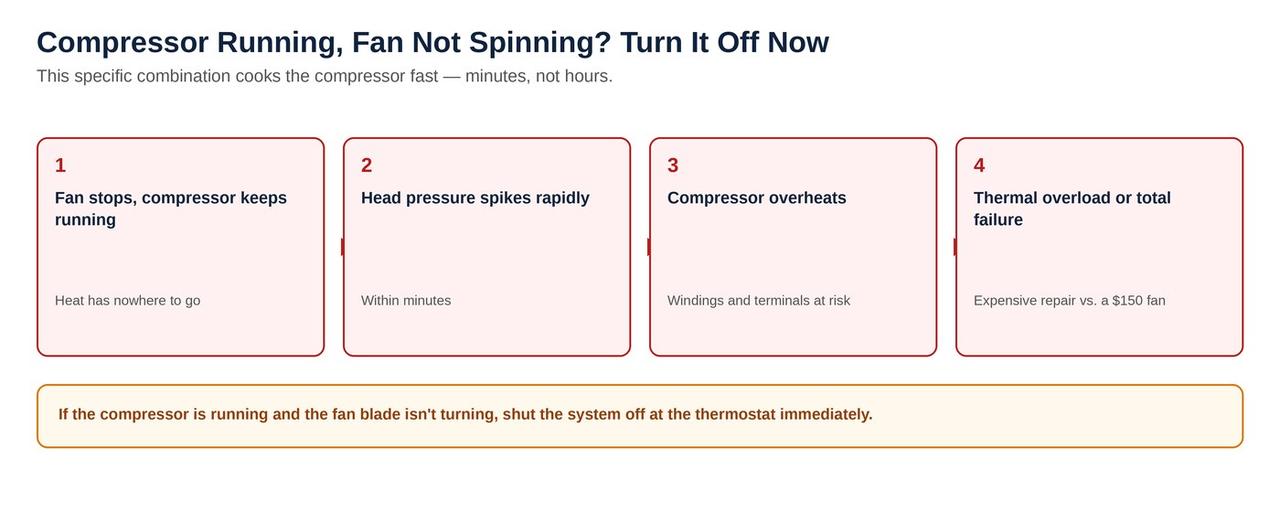
When the outdoor condenser fan stops but the compressor keeps running, it's one of the few AC problems that genuinely can't wait. Without the fan pulling air across the coil, the compressor has nowhere to send its heat and can overheat within minutes.
A weak capacitor, a failed motor, and a blocked blade all stop the fan for different reasons — and only one of them is a quick DIY-safe test.
Texas HVAC License TACLB43277C.
What This Guide Covers
Compressor Running, Fan Not Spinning? This Is Urgent
3 Reasons the Fan Won't Spin
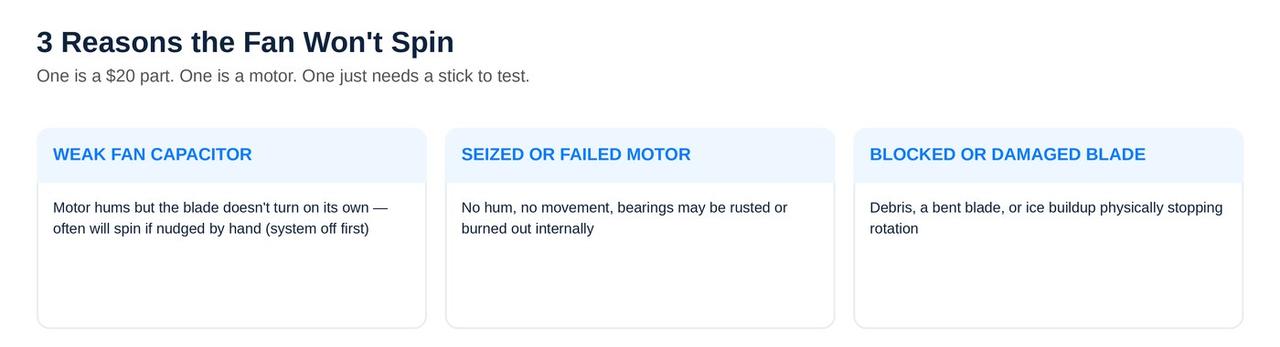
A common field test is carefully nudging the blade by hand with the system completely off — if it spins freely and the motor hums when powered, a capacitor is the likely culprit. If it doesn't spin at all or feels stuck, the motor or an obstruction is more likely. This test should only be done with the system off at the thermostat and, ideally, the disconnect pulled.
Weak or Failed Fan Capacitor
- Motor hums when powered but doesn't start on its own
- Blade spins freely by hand with power off
- Capacitance tests below its rated value
- Often the least expensive of the three causes to fix
Seized or Failed Fan Motor
- No hum, no movement at all
- Motor bearings may be rusted, dry, or burned
- Motor may be hot to the touch even when not running
- Usually requires motor replacement
Blocked or Damaged Blade
- Visible debris, leaves, or a bird's nest in the fan guard
- A bent or cracked blade physically catching on the housing
- Ice buildup on the coil or fan assembly
- Often the simplest and cheapest fix of the three
How a Technician Diagnoses a Non-Spinning Fan
- Confirm whether the compressor is running with the fan off
- Inspect for visible debris or blade damage
- Test fan motor capacitance
- Measure motor amperage and voltage
- Check motor bearing condition
- Verify airflow and condenser coil condition after repair
How a Non-Spinning Fan Is Repaired
- Replace a weak or failed fan capacitor
- Replace a seized or burned-out fan motor
- Clear debris or ice from the fan assembly
- Straighten or replace a damaged blade
- Verify compressor and system performance after the fan is restored
Repair or Replace?
Fan capacitor and motor repairs are typically inexpensive compared with the compressor damage that can result from ignoring the problem. If the compressor itself was damaged by extended overheating before the fan issue was caught, that changes the repair-versus-replace math significantly.
Outdoor Fan Not Spinning in Spring or The Woodlands?
AC Repair Expo Heating & Cooling Inc provides same-day condenser fan diagnostics throughout Spring, The Woodlands, Tomball, Cypress, Conroe, Humble, Kingwood, and nearby North Houston.
- Fan capacitor and motor testing
- Same-day service available
- Compressor protection assessment
- Condenser coil inspection
- Honest, tested recommendations
Frequently Asked Questions
Why is my outdoor AC fan not spinning?
Common causes are a weak fan capacitor, a seized or failed fan motor, or a blocked or damaged blade.
Is it dangerous if the compressor runs without the fan?
Yes. Without airflow across the condenser, head pressure can rise quickly enough to overheat the compressor within minutes.
What should I do if I notice this?
Turn the thermostat off immediately and call for service rather than letting the system keep running.
Can I test the fan myself?
With the system completely off, you can visually check for debris or blade damage, but electrical testing should be left to a technician.
How do I know if it's the capacitor or the motor?
A motor that hums but doesn't spin, and spins freely by hand when off, often points to a capacitor. A silent motor that won't move at all often points to the motor itself.
Can debris really stop the fan?
Yes. Leaves, nests, or a bent blade can physically block rotation.
How much does it cost to fix?
A capacitor replacement is inexpensive; a motor replacement costs more but is still far less than compressor damage.
Can this damage my compressor permanently?
Yes, if the compressor keeps running without airflow for an extended period.
Does the indoor unit still blow air during this?
Yes, since the indoor blower and outdoor fan are separate — that can make the problem easy to miss from inside.
How often should I check my outdoor unit?
A quick visual check each season for debris and clearance around the unit is a good habit.
Should I clear debris myself?
Only with the system fully off — leave any electrical or motor work to a licensed technician.
When should I call an HVAC technician?
Call immediately if the compressor is running with a stalled fan, or same-day for any fan that isn't spinning at all.